

The Great Wall of India
Kumbhalgarh, Rajasthan
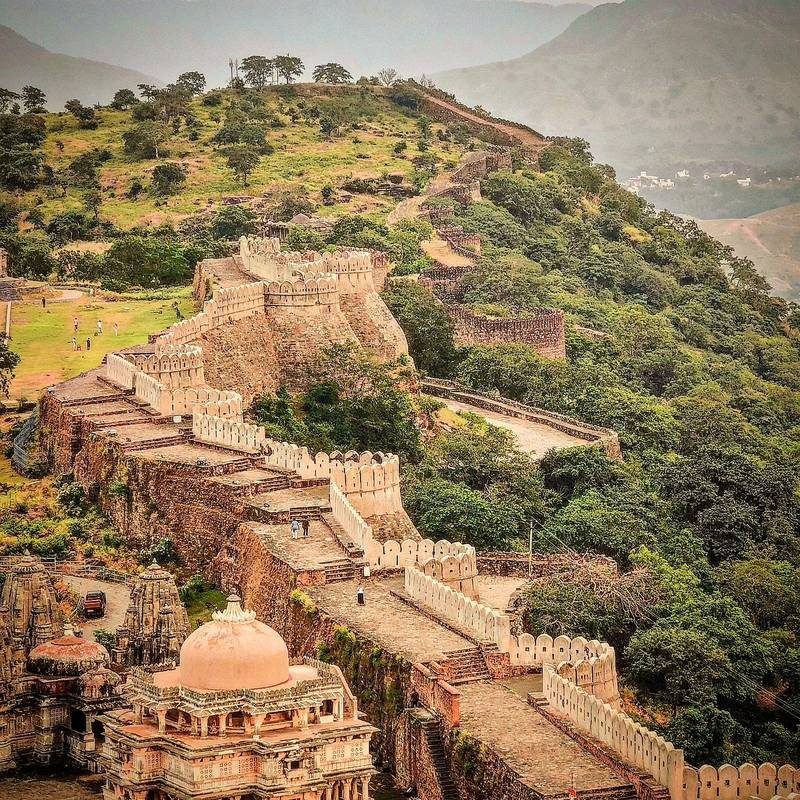
The second longest continuous wall in the world snakes across the Aravalli hills. Kumbhalgarh Fort's battlements stretch 36 kilometres, guarding ancient temples and palaces within.
Kumbhalgarh fort sits on a ridge of the Aravallis, roughly 80 kilometres north of Udaipur. Rana Kumbha of Mewar built it in the 15th century, and its outer wall runs for about 36 kilometres over the hills, enclosing palaces, farmland and dozens of temples. Since 2013 it has been one of the six Hill Forts of Rajasthan on the UNESCO World Heritage list. The pink domed building in the corner of this frame belongs to one of the temple groups inside the walls.
I climbed to a high point near the palace and looked back down the line of the wall. It had rained recently and every slope was green. Light came through a thin layer of cloud, so the stone turned a pale pink rather than the hard gold you get on a clear evening. Two people were walking the parapet halfway down. I waited until they were small, then took the picture. Beyond them the wall kept going, up the next ridge and out of sight.
Photographer's notes
- Camera
- Phone camera, main lens
- Settings
- f/1.8 · 1/320 s · ISO 50 · 26 mm equiv. (estimated from the image)
- Light
- Bright but diffused daylight through thin cloud, fairly neutral in colour, with warmth in the stone and a pale haze over the far hills.
- Composition
- Shot from above, the crenellated wall enters at the bottom right and zigzags up and back to the far ridge. The temple dome anchors the lower left corner, and the distant hills and valley fade out at the top.
- Grid
- Leading lines
License this photograph for a website or publication from ₹999 plus GST: licensing terms. The file is 1440 × 1440 pixels.
Prints from ₹499. Order this print on WhatsApp or see every photograph.
