

The Mud Coat
East Africa
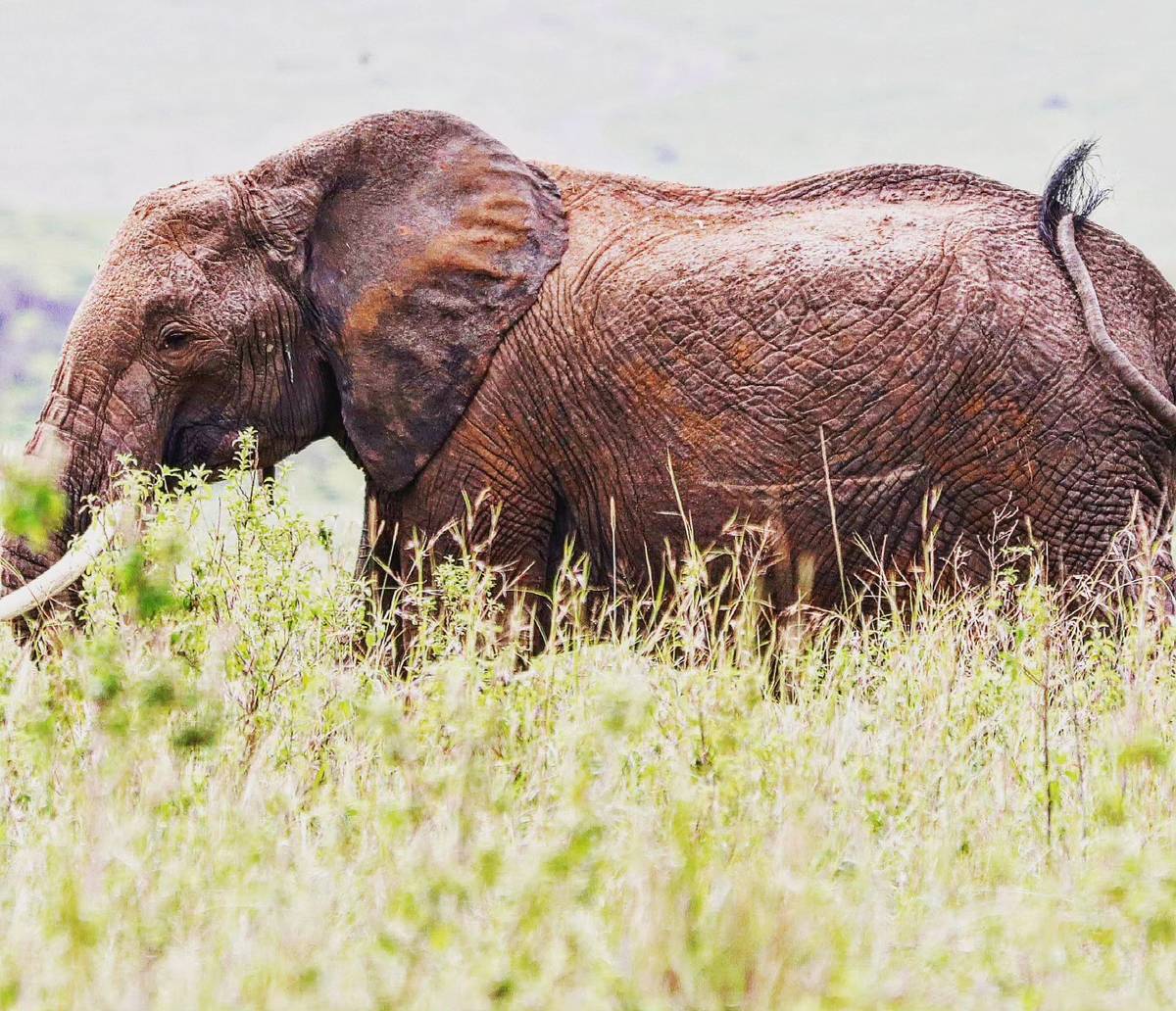
An African elephant moves through long grass, its skin still coated from a wallow. Every wrinkle holds a smear of red earth.
Elephants take mud baths and dust baths for practical reasons. The coating shields the skin from sun and biting insects, and the deep network of cracks across an African elephant's hide holds water and mud far longer than smooth skin would, which helps an animal that size stay cool. Because they use whatever ground is to hand, an elephant tends to wear the colour of the last place it stopped. This one had been somewhere red.
It was a grey, overcast day, and that suited the subject. Flat light shows texture without throwing hard shadows into every fold, so the cracks on the flank and the darker, wetter patch on the ear all read clearly. The elephant was walking left with its trunk low, and the grass came up past its knees. I used the long end of the zoom and let the animal overflow the frame at both sides, keeping one tusk at the left edge and the flicked tail at the top right. It did not look round.
Photographer's notes
- Camera
- Camera with a telephoto zoom
- Settings
- f/5.6 · 1/800 s · ISO 400 · 400 mm equiv. (estimated from the image)
- Light
- Overcast daylight, soft and even, slightly cool, with no shadows to hide the texture of the skin.
- Composition
- The elephant's body fills the frame side to side, cut off at both ends, with blurred grass forming a pale band across the lower third. The eye and tusk sit at the left, the tail curls at the upper right.
- Grid
- Fill the frame
License this photograph for a website or publication from ₹999 plus GST: licensing terms. The file is 1440 × 1238 pixels.
Prints from ₹499. Order this print on WhatsApp or see every photograph.
