

The Gharial Bank
Chambal, India
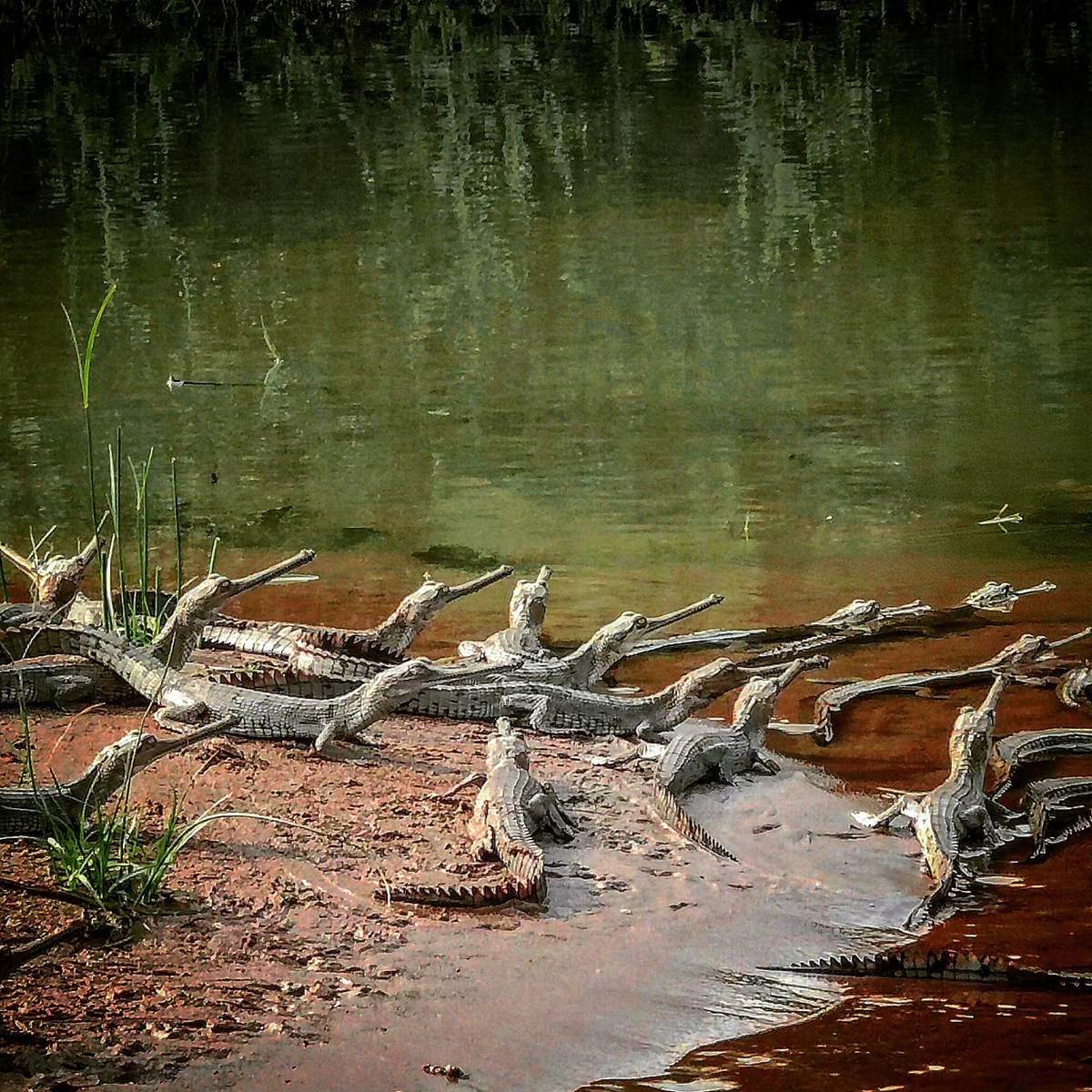
A crowd of young gharials basks on a sloping mud bank by slow green water. The narrow-snouted crocodilians of the Chambal, now critically endangered.
The gharial, Gavialis gangeticus, is listed as Critically Endangered, and the largest wild population left lives in the National Chambal Sanctuary, along the Chambal river where Rajasthan, Madhya Pradesh and Uttar Pradesh meet. It is built almost entirely for fish: a long, thin snout lined with small, sharp teeth that snaps sideways through the water. Adult males grow a bulbous lump on the tip of the snout called a ghara, after the clay pot it resembles. That is where the name comes from.
None of these had one yet. They were young animals, a couple of dozen of them, packed onto a sloping bank of wet red mud with their snouts raised at the same angle, as if listening. The afternoon light was warm and low enough to show the ridges along their backs. Behind them the river was still and green, holding reflections of the trees on the far side. I kept my distance and kept the water in the top half of the frame.
Photographer's notes
- Camera
- Phone camera, telephoto lens
- Settings
- f/2.8 · 1/500 s · ISO 100 · 120 mm equiv. (estimated from the image)
- Light
- Warm afternoon sun from the left, fairly low, raking across the young gharials and the wet mud.
- Composition
- The gharials form a band across the lower half, snouts angled up and to the right. Still green water with tree reflections fills the upper half, giving the crowded bank space to sit against.
- Grid
- Rule of thirds
License this photograph for a website or publication from ₹999 plus GST: licensing terms. The file is 1440 × 1440 pixels.
Prints from ₹499. Order this print on WhatsApp or see every photograph.
