

Mangrove Hour
Coastal India
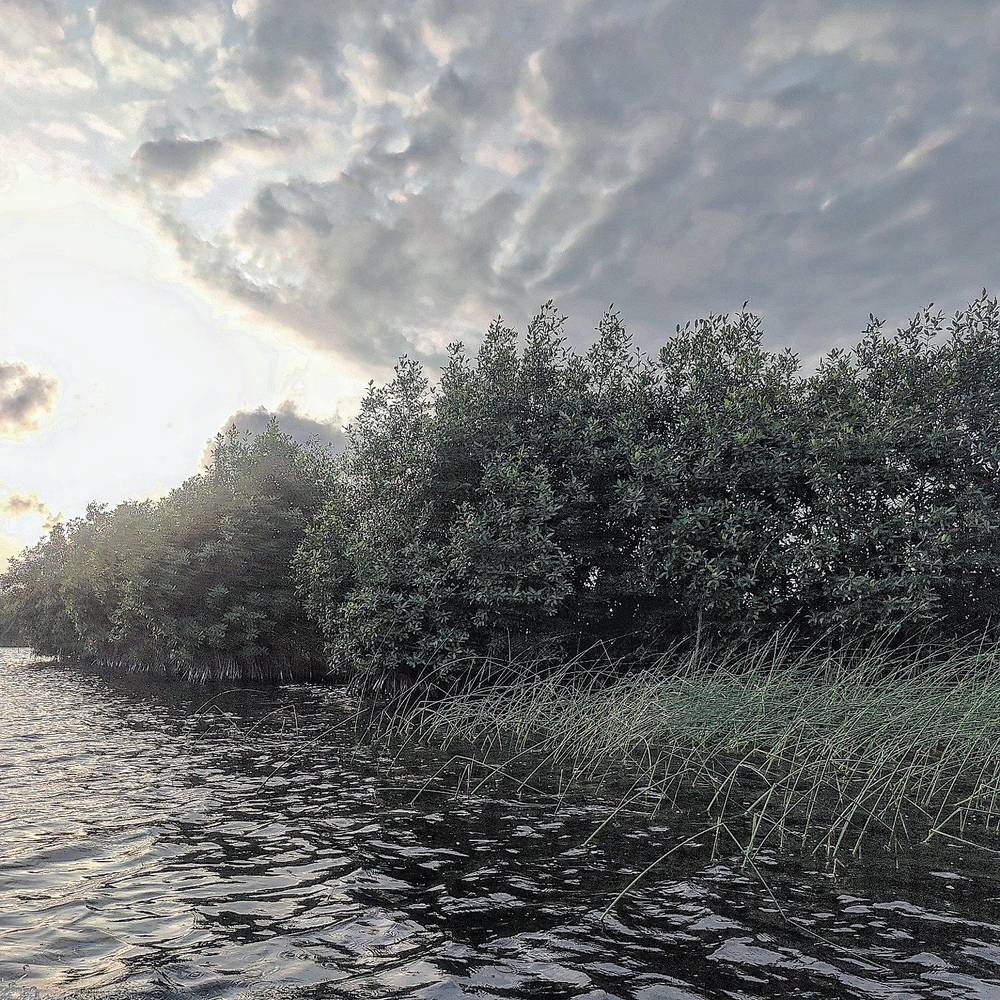
A line of mangrove crowds a slow-moving creek as the sky breaks open in pale yellows and grey. Reeds in the foreground catch the last of the light.
Mangroves are trees that grow in salt and brackish water along tropical coasts, on mud that floods twice a day with the tide. They cope by sending roots up into the air, either as arching stilts or as pencil-like spikes pushing out of the mud, and many species filter or shed salt through their roots and leaves. India's largest stand is the Sundarbans, but smaller belts line creeks and estuaries along both coasts. They hold the mud together and shelter young fish.
We had cut the engine of a small boat in a creek, and it was drifting along the edge of the trees. The sun was low on the left, behind a ragged ceiling of cloud, and it lit the mangroves from behind so their edges glowed while their faces stayed dark green. A bed of reeds stood out of the water in front of them, all leaning one way. I held the phone low near the water on the wide lens and let the line of trees run from the bright corner toward the right edge. The boat kept turning slowly. I took four or five frames, and this was the level one.
Photographer's notes
- Camera
- Phone camera, ultra-wide lens
- Settings
- f/2.2 · 1/500 s · ISO 50 · 16 mm equiv. (estimated from the image)
- Light
- Low sun behind cloud on the left, backlighting the trees, cool grey overall with a pale yellow glow at the edge.
- Composition
- The mangrove line runs from the bright left edge across to the right, splitting sky from water. Reeds fill the lower right and lean toward the light, while dark rippled water fills the lower left.
- Grid
- Diagonal
License this photograph for a website or publication from ₹999 plus GST: licensing terms. The file is 1440 × 1440 pixels.
Prints from ₹499. Order this print on WhatsApp or see every photograph.
