

Langur in the Vines
India
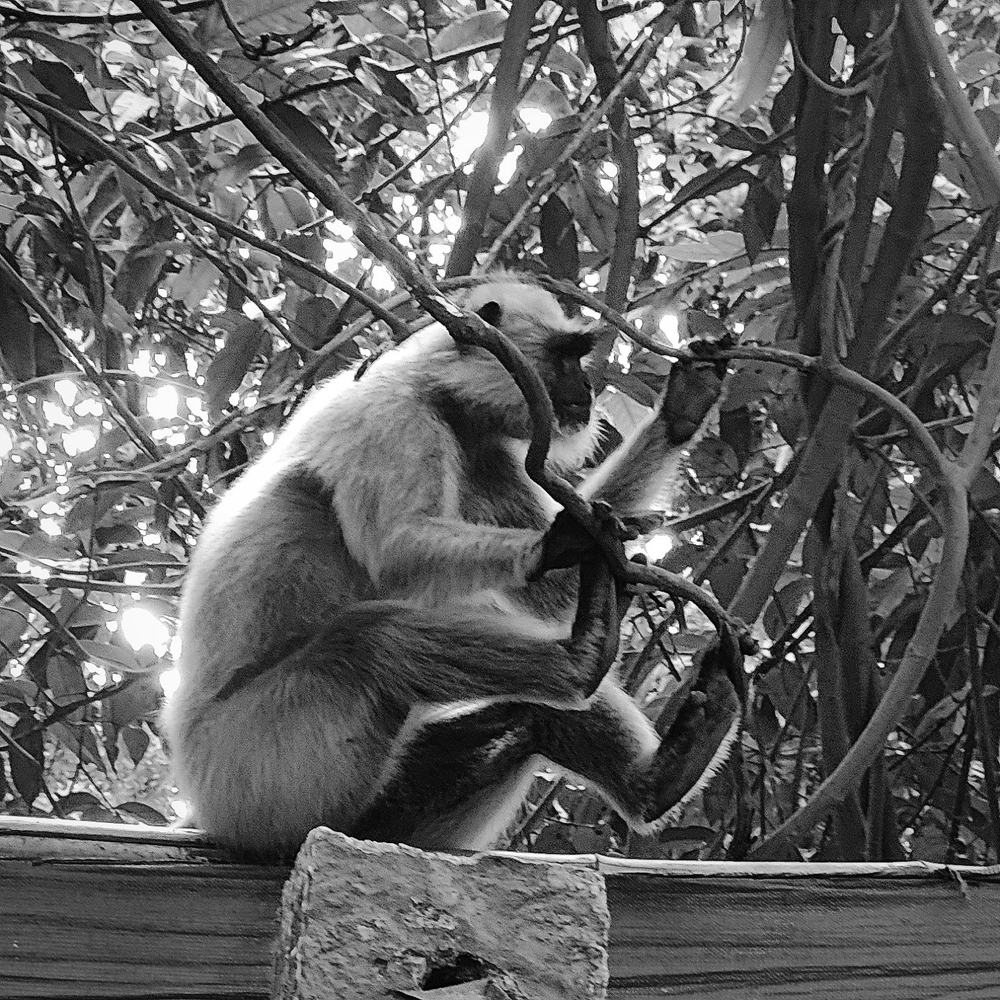
A Hanuman langur sits on a low wall, picking at a tangle of vines that fall behind it like a screen of small bright stars. Monochrome, mid-afternoon, half a frame of pattern.
Grey langurs, the genus Semnopithecus, are the long-tailed, black-faced monkeys of temple towns and dry forests across most of India. They are commonly called Hanuman langurs, and in many places they are tolerated and fed because of that association. Unlike macaques they live mostly on leaves, and their stomachs are divided into chambers where bacteria break down the tough plant matter, a little like a cow's. They spend long stretches simply sitting and digesting.
This one had settled on top of a fence post under some trees, with a woody vine hanging down in front of it. It held the vine with one hand and a foot and pulled at it now and then, without much interest. The light was behind the canopy, so the gaps between the leaves turned into bright points scattered around its head and shoulders. In colour the grey fur and green leaves were close in tone and the monkey got lost, so I took the colour out. It stayed where it was, chewing, while I took several frames.
Photographer's notes
- Camera
- Phone camera, telephoto lens
- Settings
- f/2.8 · 1/250 s · ISO 400 · 70 mm equiv. (estimated from the image)
- Light
- Afternoon backlight through a dense canopy, bright points of sky behind and a soft rim of light along the langur's fur.
- Composition
- The langur sits in profile just left of centre, its body a compact curve on top of the post. The vine runs through its hands and arcs off to the right, and the speckled canopy fills the whole background.
- Grid
- Phi grid
License this photograph for a website or publication from ₹999 plus GST: licensing terms. The file is 1440 × 1440 pixels.
Prints from ₹499. Order this print on WhatsApp or see every photograph.
