

Jute Drying
Eastern India
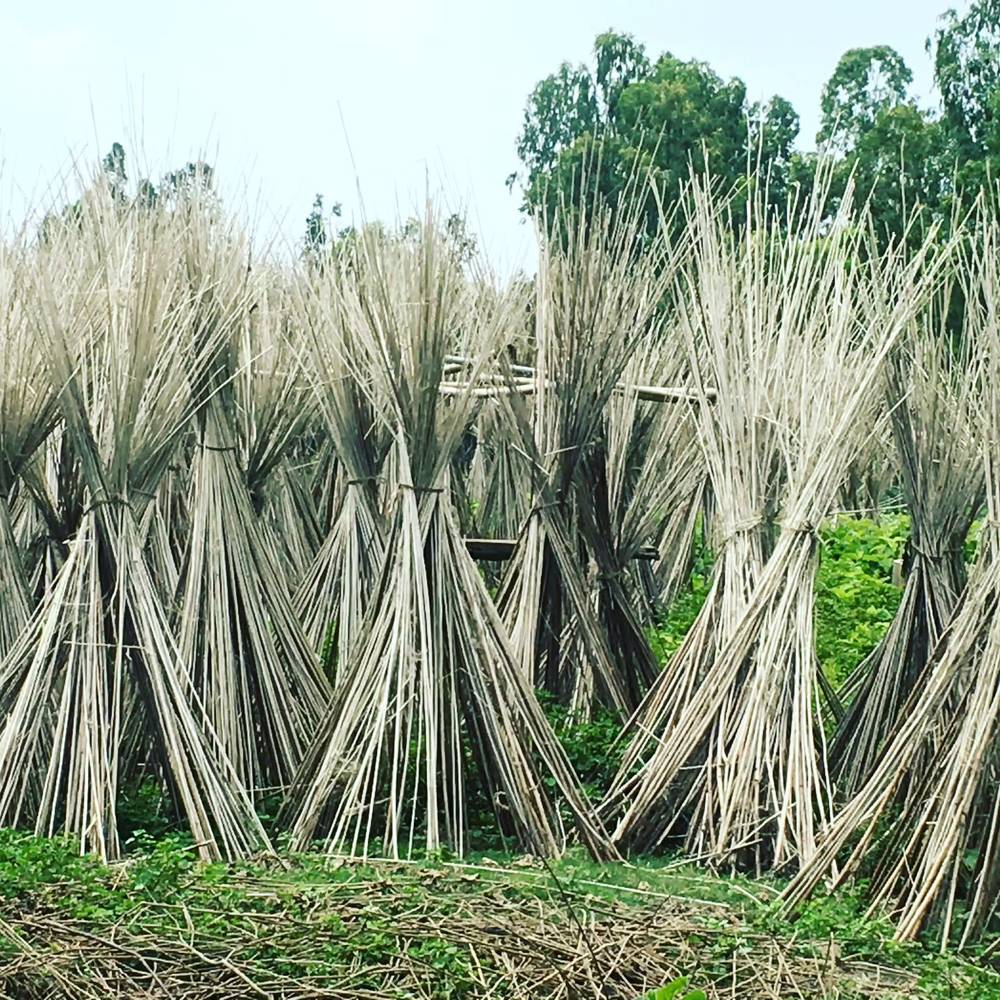
Bundles of jute stalks stand in tepees across a field, the tops fanned out to dry. A line of trees rises behind them under a pale sky.
Jute is a crop of the Ganges and Brahmaputra delta, grown across West Bengal, Assam, Bihar, Odisha and Bangladesh. The plants are cut green and sunk in ponds or ditches for a couple of weeks to rot the soft tissue, a process called retting, and the fibre is then stripped from the stems by hand. That leaves two products. The fibre goes on lines to dry. The bare stalks, called jute sticks, are stood up in cones like these, and once dry they are burned as fuel or used for fencing.
These cones covered a whole field, each one tied a little below the top so the stalks splayed out in a fan. Up close they were pale grey, almost silver. Someone had laid a bamboo pole across two of the cones near the back, and beyond them stood trees under a white, overcast sky. The weeds between the bundles were still green. I stood at the edge of the field and filled the frame with stalks, so that the tied waists of the bundles run across the middle in a loose row, with a litter of loose sticks along the bottom.
Photographer's notes
- Camera
- Phone camera, main lens
- Settings
- f/1.8 · 1/250 s · ISO 50 · 26 mm equiv. (estimated from the image)
- Light
- Even overcast daylight, bright and slightly cool, turning the stalks silver-grey and leaving the sky white.
- Composition
- The cones march across the full width, their tied waists making a rough line through the middle and their fanned tops filling the upper half. Trees close off the top right and a band of loose sticks and weeds anchors the bottom.
- Grid
- Fill the frame
License this photograph for a website or publication from ₹999 plus GST: licensing terms. The file is 1440 × 1440 pixels.
Prints from ₹499. Order this print on WhatsApp or see every photograph.
