

Eternal Marble
Agra, Uttar Pradesh
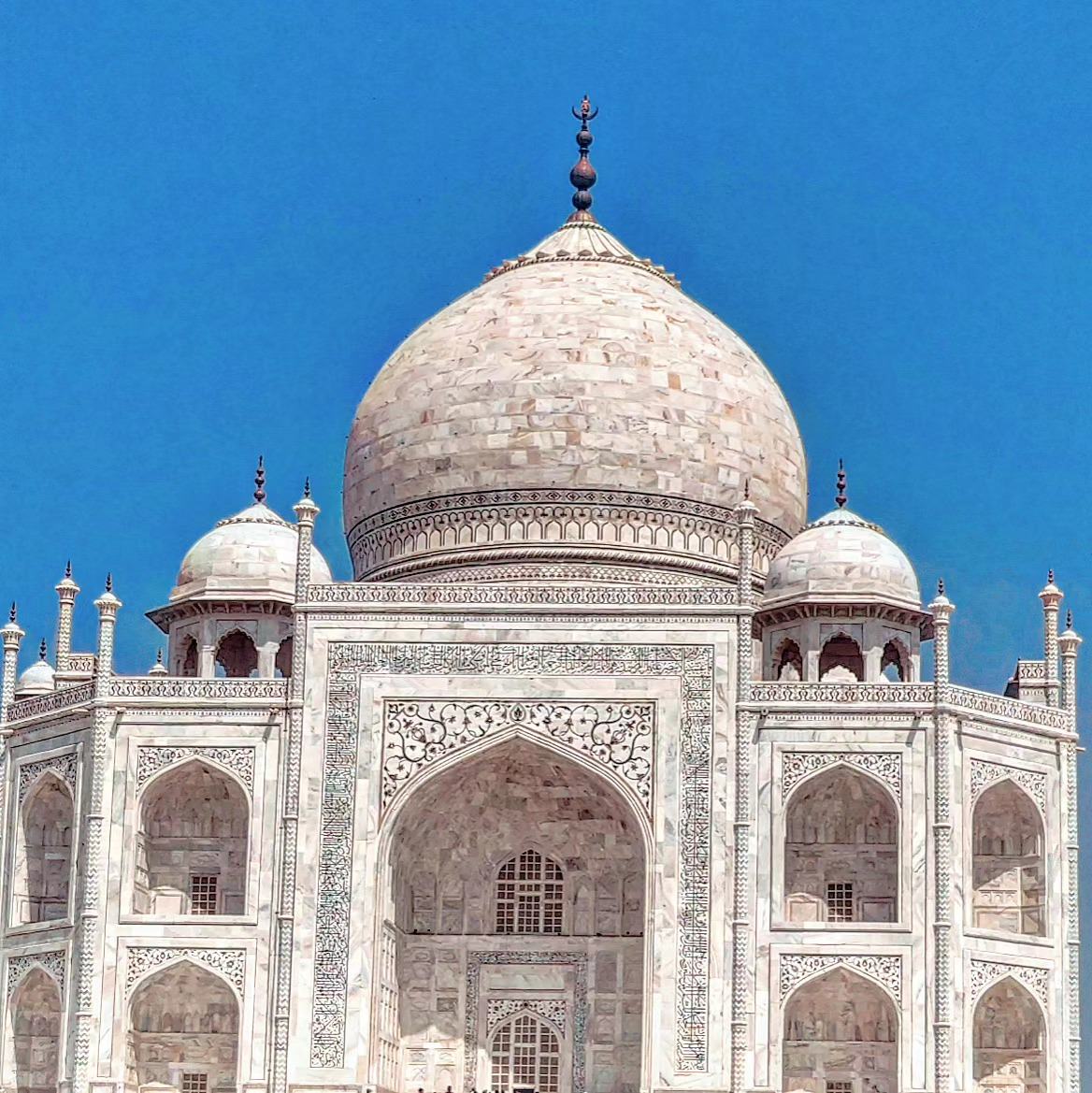
The dome of the Taj Mahal, cropped tight so the crowds fall below the frame. Just marble, sky, and the geometry of grief made beautiful.
Shah Jahan began the Taj Mahal in 1632 as a tomb for his wife Mumtaz Mahal, who died the year before. The mausoleum was finished in the 1640s and the wider complex around 1653. It is faced in white marble from Makrana in Rajasthan, inlaid with semi-precious stone, and the arch frames carry verses from the Quran in black marble letters that grow taller as they rise, so they read evenly from the ground.
I went in the full glare of a clear afternoon, which every guide tells you not to do. The crowd was solid at ground level, so I cropped it out and kept only the top of the building against the sky. The blue was flat and hard. In this light the dome shows its joints: you can see the separate blocks of marble and the faint grey veins in them. A crescent finial sits on top.
Photographer's notes
- Camera
- Phone camera, telephoto lens
- Settings
- f/2.8 · 1/2000 s · ISO 50 · 70 mm equiv. (estimated from the image)
- Light
- Hard midday sun from high and slightly left, bright white on the marble under a deep, cloudless blue sky.
- Composition
- The building is centred and cut off at the base, with the main dome and finial on the vertical axis. The small domed kiosks and corner pinnacles balance each other on either side, and the sky fills the top half as clean negative space.
- Grid
- Symmetry
License this photograph for a website or publication from ₹999 plus GST: licensing terms. The file is 1168 × 1169 pixels.
Prints from ₹499. Order this print on WhatsApp or see every photograph.
