

Impala, Looking Past
Maasai Mara, Kenya
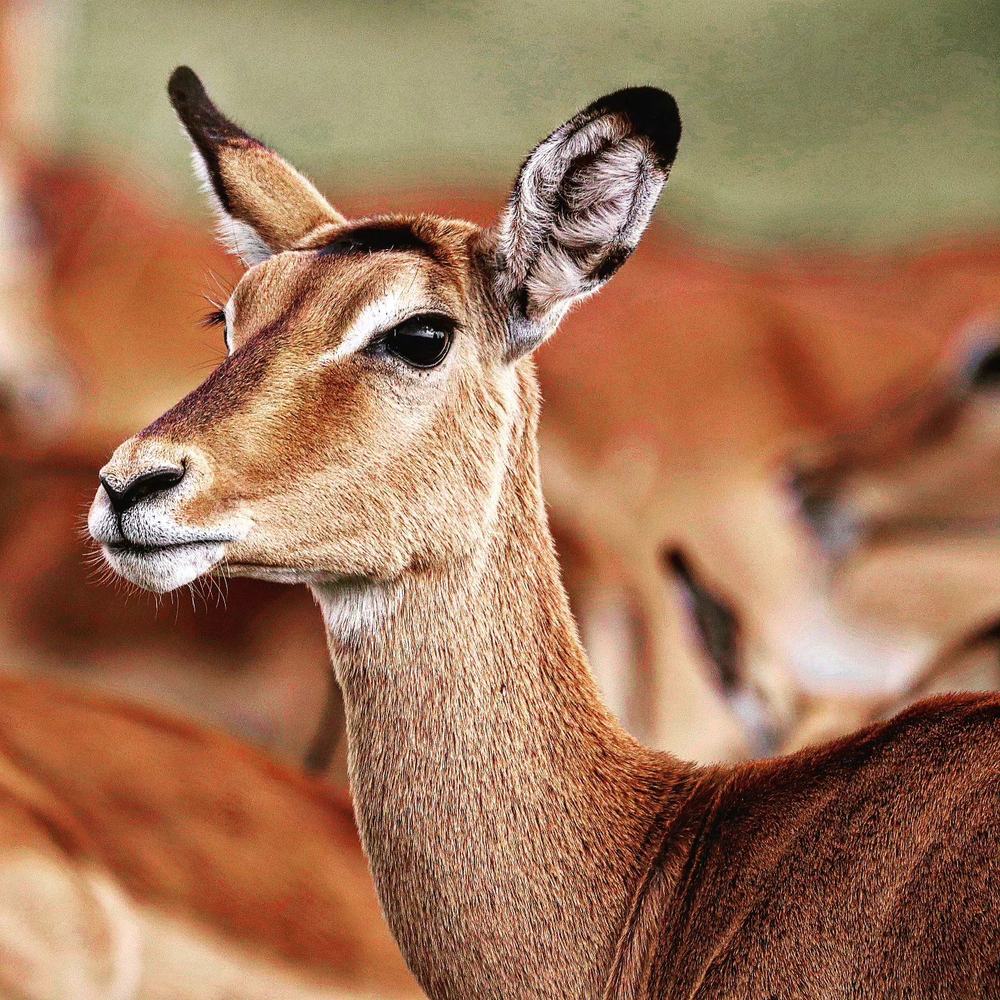
A female impala in tight portrait, the herd blurred behind her in warm rust-brown. The ear is half-rotated, the eye absolutely steady, the white throat catching what light there is.
Impala, Aepyceros melampus, are among the most numerous antelope in East and southern Africa, which is why so many safari drivers do not slow down for them. Only the males carry horns, long and lyre-shaped. Females like this one live in large herds with their young. Look at one from behind and you see two black stripes running down the thighs on either side of the tail, and the pattern is easy to follow when a herd breaks and runs.
This female stood near the edge of a big herd, close enough to the track to fill the lens. The rest were grazing or resting, all in different shades of rust and fawn, so behind her they blurred into bands of colour. She turned her head to look at something past us and held still. I framed tight on the head and neck, with her face in the left half and the herd behind. The black tips of both ears are sharp. So are the white chin and the line of pale hair above the eye. Then she dropped her head to graze.
Photographer's notes
- Camera
- Camera with a telephoto zoom
- Settings
- f/5.6 · 1/800 s · ISO 400 · 400 mm equiv. (estimated from the image)
- Light
- Soft overcast daylight, even across the face and slightly warm in the coat, with a small highlight in the eye.
- Composition
- The head sits in the upper left third, turned toward the open space on the left, and the neck runs down to the lower right where the body leaves the frame. The long lens reduces the herd behind her to bands of rust and fawn.
- Grid
- Rule of thirds
License this photograph for a website or publication from ₹999 plus GST: licensing terms. The file is 1440 × 1440 pixels.
Prints from ₹499. Order this print on WhatsApp or see every photograph.
