

Bougainvillea in Monochrome
India
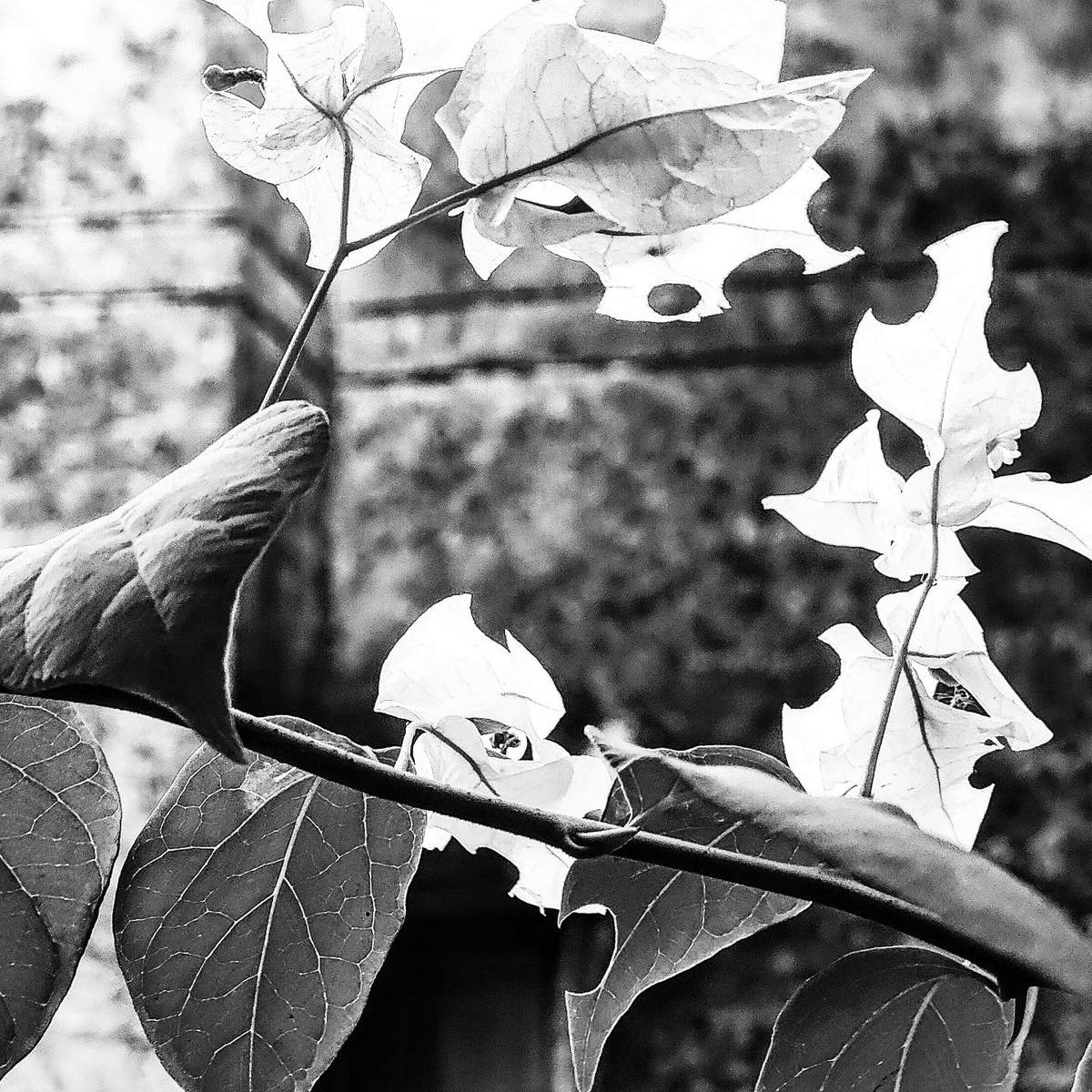
Black and white study of bougainvillea bracts lit almost white against dark leaves, a few of them chewed through with round holes.
Bougainvillea comes from South America and takes its name from Louis Antoine de Bougainville, the French navigator on whose voyage it was recorded for European science. What looks like a flower is mostly bracts: thin, papery modified leaves, in groups of three or six. The real flowers are small white tubes sitting in the middle of them. Across Indian cities it grows over walls, gates and road dividers, and it flowers hardest when it is kept a little dry.
Something had been eating these. Several bracts had round holes in them, and in colour the damage looked messy. I switched to black and white and the holes turned into shapes. The sun was behind the plant, so the bracts went close to white while the leaves in front stayed dark and veined. Behind them was a hedge and a wire fence, far enough back to blur into grey. A thick stem crosses the lower half of the frame, and I kept it because it holds the light part and the dark part together.
Photographer's notes
- Camera
- Phone camera, main lens
- Settings
- f/1.8 · 1/1000 s · ISO 50 · 26 mm equiv. (estimated from the image)
- Light
- Strong backlight from a high sun, shining through the thin bracts and rendering them almost white. Converted to monochrome, with deep shadow on the leaves.
- Composition
- Bright bracts cluster in the upper half and on the right, while dark leaves fill the bottom left. A stem runs as a diagonal across the lower third, separating the two, and the blurred hedge gives a mid-grey ground behind.
- Grid
- Diagonal
License this photograph for a website or publication from ₹999 plus GST: licensing terms. The file is 1440 × 1440 pixels.
Prints from ₹499. Order this print on WhatsApp or see every photograph.
