

Tulsi Gone to Seed
India
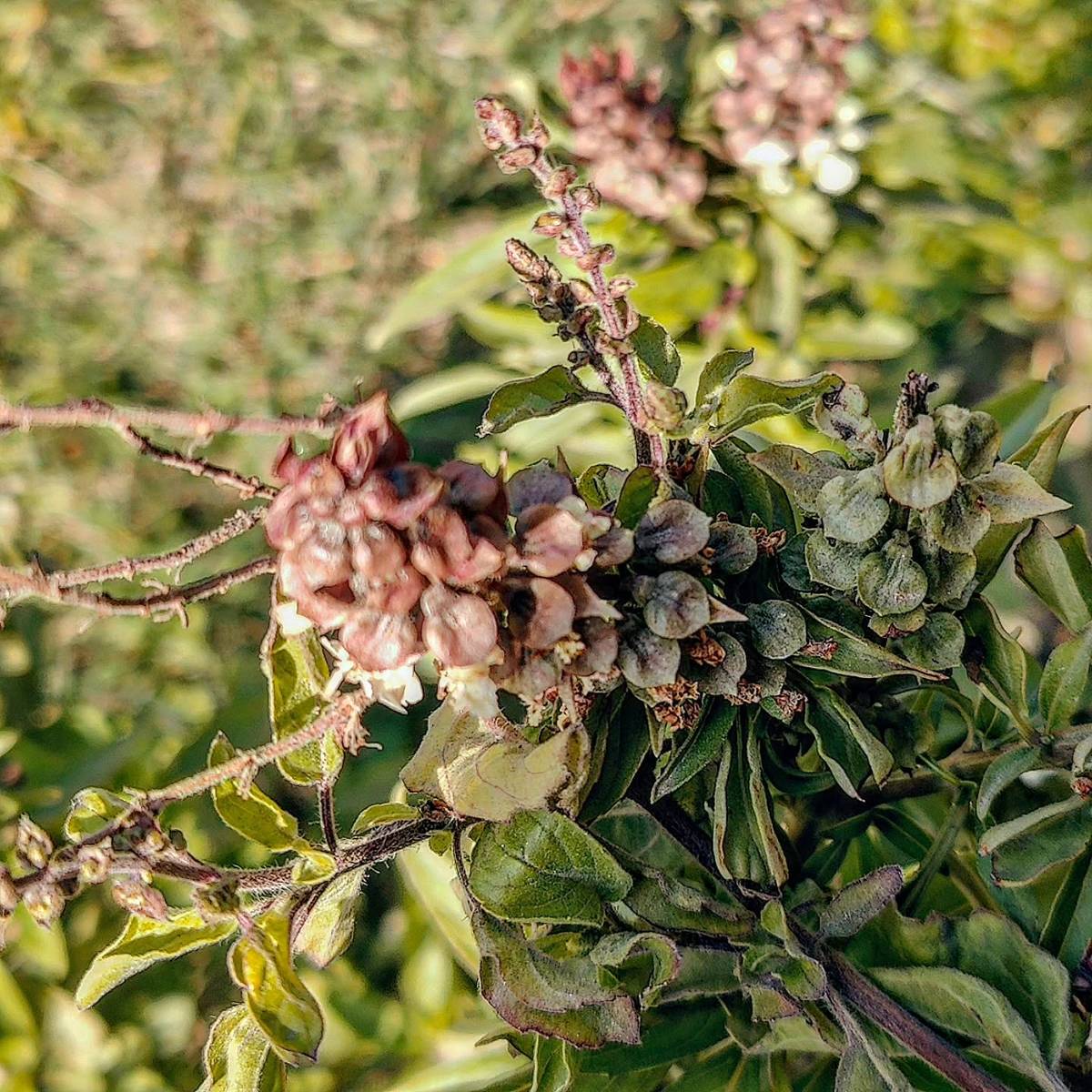
Holy basil gone to seed, its purple-stemmed spikes crowded with papery calyces turning from green to rust brown.
Holy basil, Ocimum tenuiflorum, is tulsi. It grows in a pot or a raised stand in the courtyard of a great many Indian homes, and for Hindu households it is a sacred plant, watered and circled in the morning. Its leaves go into tea. Left alone, it flowers on thin spikes and then sets seed, each tiny seed held in a calyx that swells into a papery cup. Gardeners pinch the spikes off to keep the plant leafy. Somebody had stopped pinching this one.
The purple stems told me it was the dark kind, often sold as Krishna tulsi. The calyces were at every stage at once: green and plump near the tips, rust brown and splitting further back, a few already empty. It was late afternoon and the sun came from the left, warm and low, so each cup threw a small shadow onto the next. The grass beyond was full of the same light. I framed the cluster across the middle, the dry spikes reaching into the blur on the left.
Photographer's notes
- Camera
- Phone camera, main lens
- Settings
- f/1.8 · 1/1000 s · ISO 50 · 26 mm equiv. (estimated from the image)
- Light
- Warm late-afternoon sun from the left, low enough that each seed cup shades the next. Golden light carries into the blurred grass behind.
- Composition
- The seed cluster runs across the centre of the frame from the dry spikes on the left to the green leaves on the right. A taller spike rises toward the top, and the background falls into a warm green blur.
- Grid
- Diagonal
License this photograph for a website or publication from ₹999 plus GST: licensing terms. The file is 1440 × 1440 pixels.
Prints from ₹499. Order this print on WhatsApp or see every photograph.
